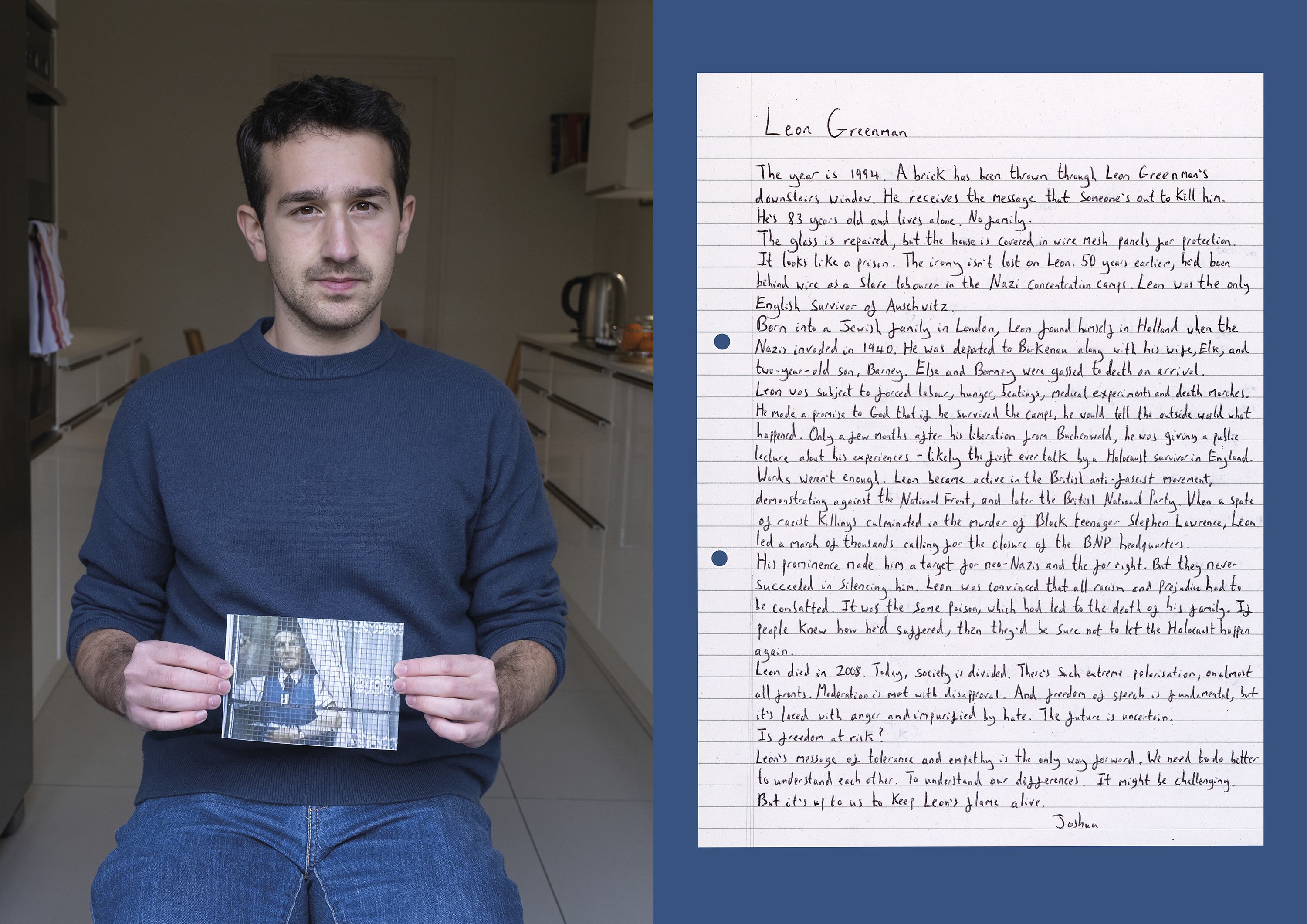
Leon Greenman
The year is 1994. A brick has been thrown through Leon Greenman’s downstairs window. He receives the message that someone’s out to kill him. He’s 83 years old and lives alone. No family.
The glass is repaired, but the house is covered in wire mesh panels for protection. It looks like a prison. The irony isn’t lost on Leon. 50 years earlier, he’d been behind wire as a slave labourer in the Nazi concentration camps. Leon was the only English survivor of Auschwitz.
Born into a Jewish family in London, Leon found himself in Holland when the Nazis invaded in 1940. He was deported to Birkenau along with his wife Else, and two year old son, Barney. Else and Barney were gassed to death on arrival.
Leon was subject to forced labour, hunger, beatings, medical experiments and death marches. He made a promise to God that if he survived the camps, he would tell the outside world what happened. Only a few months after his liberation from Burchenwald, he was giving a public lecture about his experiences – likely the first ever talk by a Holocaust survivor in England.
Words weren’t enough. Leon became active in the British anti-fascist movement, demonstrating against The National Front, and later the British National Party. When a spate of racist killings culminated in the murder of Black teenager Stephen Lawrence, Leon led a march of thousands calling for the closure of the BNP headquarters.
His prominence made him a target for pro-Nazis and the far right. But they never succeeded in silencing him. Leon was convinced that all racism and prejudice had to be combatted. It was the same poison, which had led to the death of his family. If people knew how he’d suffered, then they’d be sure not to let the Holocaust happen again.
Leon died in 2008. Today, society is divided. There’s such extreme polarisation, on almost all fronts. Moderation is met with disapproval. And freedom of speech is fundamental, but it’s laced with anger and impurified by hate. The future is uncertain.
Is freedom at risk?
Leon’s message of tolerance and empathy is the only way forward. We need to do better to understand each other. To understand our differences. It might be challenging. But it’s up to us to keep Leon’s flame alive.
Joshua.